In this article
- What a film production company actually does
- What to look for in a production company’s work
- What a cheap quote usually leaves out
- Working with agencies, or directly with production
- Questions to ask before you sign anything
- The mistakes that cost the most
- What a professional timeline looks like
- Frequently asked questions
- The right production partner
How to choose a film production company in Switzerland without overspending or compromising the result?
Most companies pick a production partner by watching a reel, liking the visuals, and requesting a quote. That process skips every question that actually determines whether the project succeeds or fails. The reel shows what a company has made. It says nothing about whether they can solve your specific problem, with your budget, on your timeline.
A more reliable process works like this.
First, define what you need the film to do for your business. Not what it should look like. In other words, what should the film achieve?
Second, check whether the company has made films at a similar scope. Not similar style. Similar scope. A company that shoots corporate videos and a company that produces narrative commercials are not the same company, even if both call themselves a film production company.
Third, ask about process. A company that can’t describe how they get from brief to delivery in concrete steps probably doesn’t have a reliable process.
Fourth, read the budget. Not the total. The lines. If the quote is a single number with no breakdown, that’s your first warning.
Fifth, talk to the people who will actually lead the project. Not the sales contact. The director. The producer. If you can’t access them before signing, you won’t access them during.

What a film production company actually does
The term film production company covers everything from a solo videographer with a camera to a 40-person crew shooting a national campaign. Both exist in Switzerland. Both are legitimate. They serve completely different needs, and confusing the two is one of the most expensive mistakes a client can make.
Here is what changes between formats:
| Format | What it is | Crew | Timeline | Realistic budget (CHF) |
|---|---|---|---|---|
| Corporate video | Interview, testimonial, process explainer | 2 to 5 | 2 to 4 weeks | 5’000 to 25’000 |
| Branded content | Brand film, lifestyle, emotional storytelling | 5 to 15 | 4 to 10 weeks | 15’000 to 80’000 |
| Narrative commercial | Campaign film with script, cast, locations, art direction | 10 to 30+ | 8 to 16 weeks | 40’000 to 200’000+ |
Note: crew size, timelines, and budget in this table reflect common formats. These are not fixed rules. A corporate video can involve a crew of more than 30 people at a higher budget if the brief calls for it.
A corporate video needs a good camera operator, clean audio, and a competent editor. A narrative commercial needs a director, a DoP, an art department, a casting process, a sound recordist, a colourist, often a composer, and many more people involved.
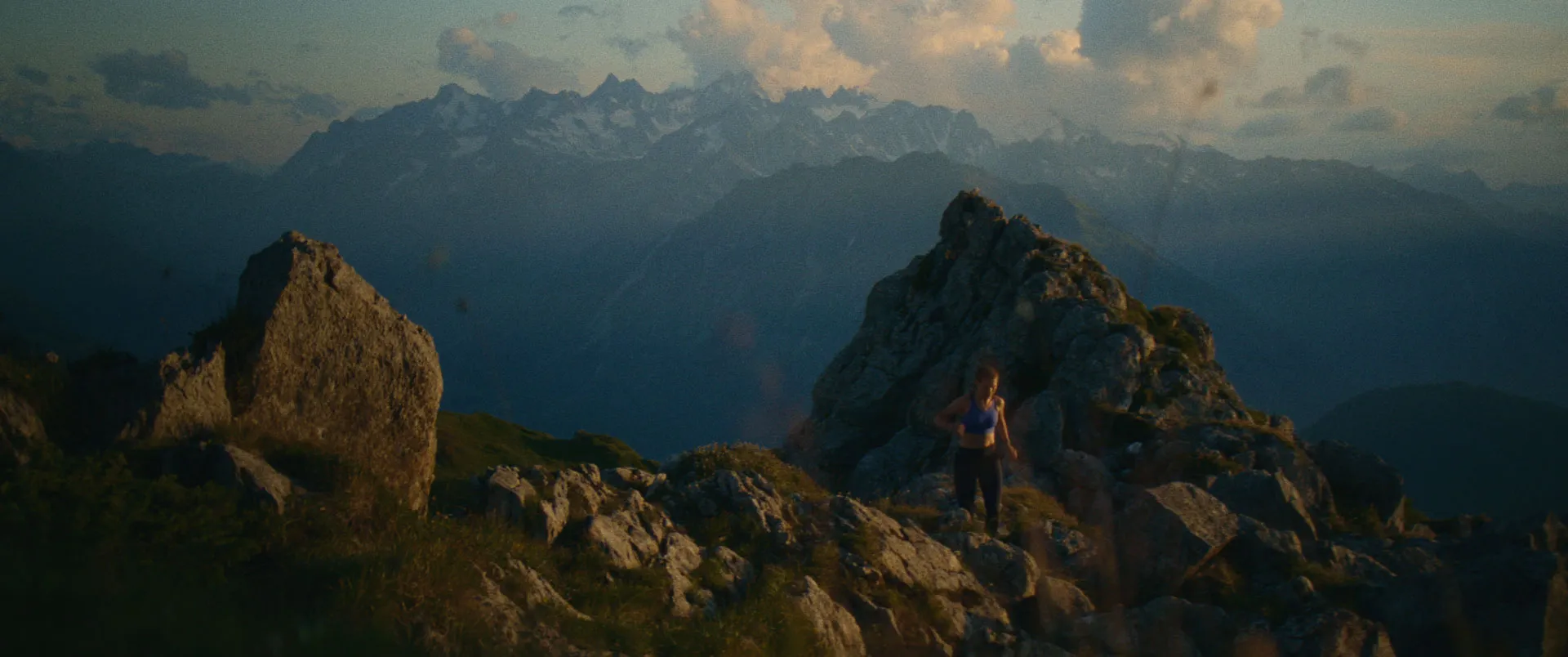
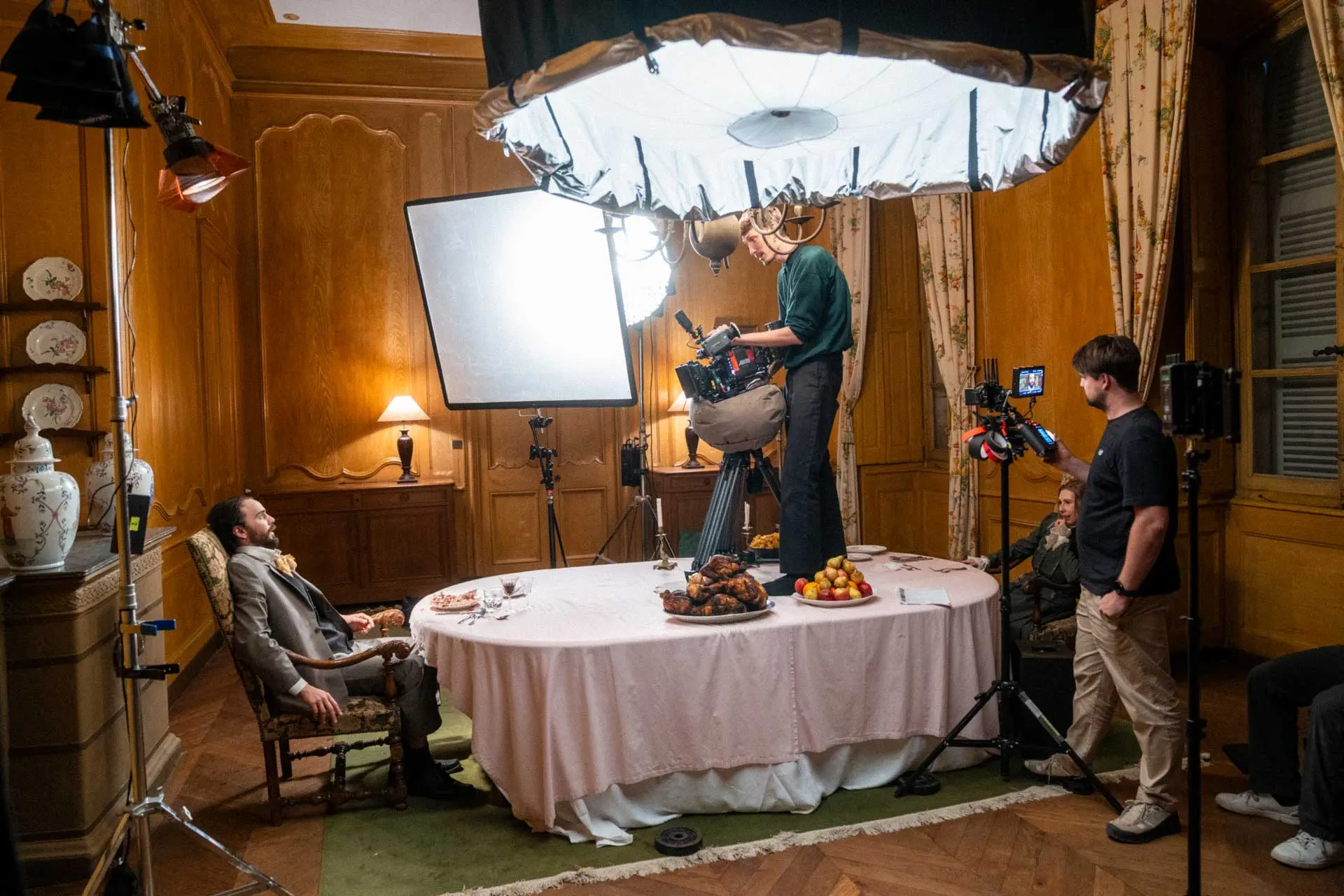
When Born to run was produced as a spec narrative commercial for On Running, the calculated budget was CHF 90’271. That covered two shoot days, a lead actress across three timelines, extras, multiple locations in Valais, a crew of more than 15, original music, and full post-production. A corporate video interview could cost a fraction of that. The difference is scope.
If you’re looking for a film production company, the first conversation should establish which format your project actually needs. A serious film production company will tell you which format your project needs. A company chasing the job will quote for the maximum scope.
If the format question hasn’t been settled before that first conversation, it’s worth resolving first. Our breakdown of commercial, institutional film, and branded content maps each format to its business objective, audience, and typical production scope, so the shortlist conversation starts from a defined brief rather than a vague one.
What to look for in a production company’s work
Reviewing the portfolio is the standard advice, and on its own it’s not enough. Here’s what to do when you watch a production company’s work.
Watch three or four films, not one. A single strong piece tells you very little about the production company. What matters is consistency across different clients, different budgets, different constraints. If the level holds, it’s not luck. It’s a system.
Watch with the sound off for ten seconds, then with the sound on. If the image looks flat, evenly lit, and generic with the sound off, the cinematography wasn’t directed. If the dialogue sounds echoey, thin, or buried under music with the sound on, the sound wasn’t recorded properly on set or mixed properly in post.
Check the format match. A company with a reel full of music videos isn’t automatically the right choice for a branded content campaign. The production logic is different. Music videos are performance-driven and edited to rhythm. Branded content is narrative-driven and edited to story.
Look at how actors perform. If the actors in a commercial feel like real people in a real situation, the director knows how to direct performance. If they feel like they’re performing for camera, reciting lines with a smile, the director doesn’t.
What a cheap quote usually leaves out
Swiss commercial production has a cost floor. Crew rates are defined by the SSFV framework. Equipment rental has published day rates. Post-production takes the hours it takes. A detailed breakdown of what Swiss commercial production costs is available in our pricing guide.
When a quote comes in 40% below market, the production company hasn’t found a hidden efficiency. They’ve removed line items. The question is which ones.
Here is what typically gets cut:
- Pre-production. No location scouting. No rehearsal. No storyboard. The shoot day becomes the first time anyone figures out what the film will look like. That improvisation costs time on set, and time on set costs money in overtime. On a Swiss commercial shoot, a 9-hour base day with a 15-person crew might cost CHF 8’000 to 12’000 in crew alone. Push that to 13 hours because of poor planning and the overtime adds CHF 4’000 to 6’000, for a total of CHF 12’000 to 18’000.
- Crew size. Fewer specialists, more roles combined on single shoulders. The shoot loses precision, pace, and the capacity to solve problems as they come up.
- Colour grading. No dedicated colourist, just an editor applying a generic correction. Shots don’t match across the film and the inconsistency is noticeable.
- Music and licensing. Stock track instead of an original composition. The film ends up sounding like every other film that pulled from the same library.
- Revision rounds. Not included in the quote. First round is free. Second round, you get an invoice.
- Project management. Fewer check-ins, looser coordination, tighter communication windows. Small misalignments compound into surprises by delivery.
A smaller budget isn’t the problem. Good work can be made at CHF 10’000 or CHF 25’000 if the scope matches. The problem is when a client expects narrative commercial quality at corporate video prices. Those are two different formats, with two different crew structures, and two different cost floors.
Working with agencies, or directly with production
Some projects are film-first. The film is the main deliverable for the client, and the conversation is about story, cast, locations, and craft. For this kind of project, working directly with a production company keeps the process shorter.
Other projects are campaigns. The film sits alongside media buying, print, digital, out-of-home, and a broader communication strategy. In that setup, an agency is the natural lead. They coordinate the full campaign and bring the production company in to handle the film itself. It works because each partner focuses on what they do best: the agency carries the strategy and the campaign architecture, the production company carries the film, hand in hand.
The two setups answer different briefs. A narrative commercial meant to live on its own goes directly from client to production company. A multi-channel campaign where the film sits alongside print, digital, and media buying goes through an agency that holds the whole thing together. The difference is the number of people in the room, not the quality of the outcome.
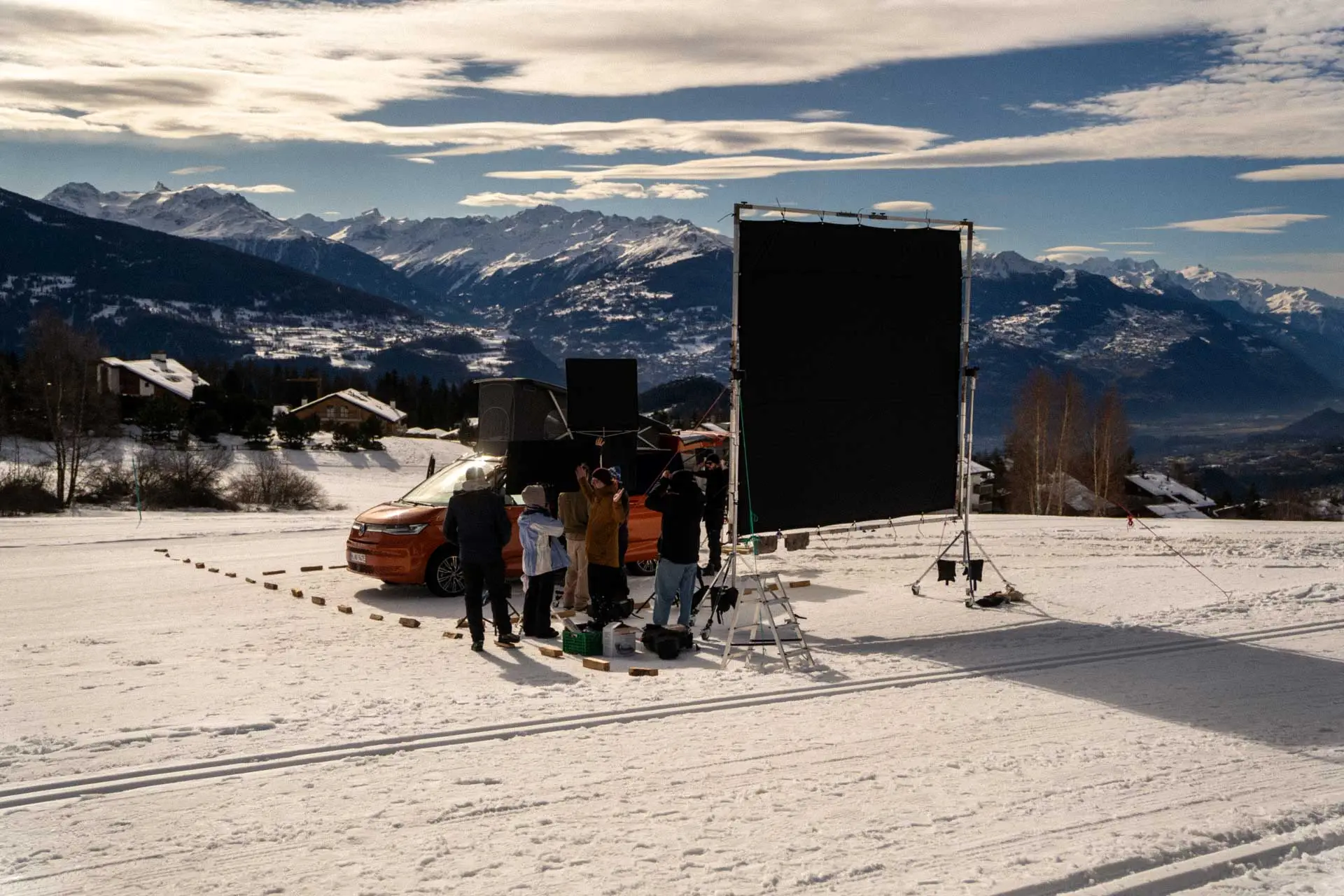
When the Volkswagen California branded content film was produced, the shoot happened in Crans-Montana with the production team working directly with the client. On campaign work, the agency leads the creative direction across every channel and the production company delivers the film inside that framework. Both setups produce good films when the structure matches the brief.
Questions to ask before you sign anything
Who leads the project? Not the company. The person. What is their name and what is their role? If the person who sells you the project isn’t the person who makes it, find out who is.
What does the budget include? Pre-production, shoot, post, equipment, crew, music, colour, sound, deliverables. If the answer is a single lump sum, ask again.
How many revision rounds? And what happens after those rounds? Some companies include two rounds. Some include unlimited. Some include zero, and you find out when the first invoice for changes arrives. This is usually indicated in the contract you sign with the film production company.
What happens if the shoot runs long? On a Swiss set, overtime kicks in after 9 hours. Hours 10 and 11 are billed at 125%. Hours 12 and 13 at 150%. If nobody has planned for that possibility, you’ll be surprised by the final invoice.
What deliverables are included? The master film, social cutdowns, vertical versions, stills, behind-the-scenes. If these aren’t in the quote, they aren’t included. Deciding you need Instagram cutdowns after delivery means re-opening the edit, and re-opening the edit often means an invoice.
What usage rights are covered? In Switzerland, actor buyouts are calculated per media channel, per year. National TV is 100% of the actor’s day rate. Online paid is another 100%. Owned digital is 50%. A campaign running on three channels for two years can double the cast budget. This is standard. If nobody mentions it before signing, ask.
How does the timeline of the project look? A professional production company will give you a clear, structured timeline with defined milestones. You should see each phase laid out, from pre-production through to delivery, including key steps like recce, approvals, shoot days, post-production, and final assets.
The mistakes that cost the most
Hiring a corporate video team for a narrative commercial. Both formats may use similar tools, but they rely on different approaches. A corporate video focuses on efficiency and clarity. A narrative commercial builds around performance, art direction, lighting, and story. The structure, the crew, and the time required are not the same. When these two formats are treated as interchangeable, the result often falls short of expectations.
Starting without a clear objective. A film meant to “build awareness” without a defined audience, message, or platform will look fine and do nothing. Define the business objective before the brief. What should this film change about how people think, feel, or act?
Underestimating post-production. Post-production is not just editing. It’s colour grading, sound design, retouches, original music or licensing, mix, versioning, and delivery across multiple formats. Cutting the post budget cuts the quality of everything shot on set. On Born to run, post-production was 29% of the total budget.
Choosing on reel alone. A reel is a highlight. It shows the best shots from the best projects. Ask to see full films. Ask who directed them. Ask who will direct yours.
Ignoring distribution. A film shot in 16:9 for cinema that needs to run on Instagram Stories in 9:16 will either be cropped badly or reframed in post. Aspect ratios, hook structure, platform durations, and cutdown strategy should be in the production plan from day one.
What a professional timeline looks like
For a narrative commercial or branded content film in Switzerland, here is a realistic production timeline:
| Phase | Duration | What happens |
|---|---|---|
| Brief and strategy | 1 to 2 weeks | Business objective, audience, format, key message |
| Development | 1 to 3 weeks | Treatment, script, director’s vision, budget |
| Pre-production | 2 to 4 weeks | Casting, location scouting, crew, scheduling, production design, rehearsal |
| Shoot | 1 to 4 days | On-set production |
| Post-production | 3 to 5 weeks | Edit, colour, sound, music, retouches, versioning |
| Delivery | 1 week | Final exports, platform formats, handover |
| Total | 8 to 16 weeks |
These numbers are realistic. They can compress if the scope is small and decisions happen fast. They stretch if the project involves named talent, multiple locations, or complex post-production.
Every production sits inside a triangle of quality, time, and budget. You pick two. A film that is fast and high quality will cost more. A film that is cheap and fast will be lower quality. A film that is cheap and high quality will take longer. There is no trick to getting all three. Discuss the trade-off openly with your producer before the project starts.
For a stage-by-stage look at what actually happens inside each of those phases, from the triple bid and treatment through to delivery and rights clearance, our guide to how a commercial film production works goes through all ten stages in sequence.
Frequently asked questions
What questions should you ask before signing with a production company?
Ask who will lead the project by name and whether they will be on set. Ask how many revision rounds are included and what happens beyond that. Ask what deliverables and usage rights are covered. Ask what happens if the shoot runs over schedule. If any of those answers are vague, treat that as information.
How do you evaluate the execution quality of a production company?
Watch three or four films, not just the showreel. Check the lighting in indoor scenes: flat and even means uncontrolled, shaped and directional means someone made deliberate choices. Listen to the dialogue: clean and present means it was recorded properly, echoey or thin means it wasn’t. Watch how actors perform. If they feel natural, the director knows how to direct. Look for consistency across projects rather than one great piece.
Should you work with an agency or directly with a production company?
There is no rule behind that question, but work directly with a production company when the film is the main deliverable. Work with an agency when the film is part of a broader campaign and if you don’t have a marketing team within your company.
How much does a film production company cost in Switzerland?
A corporate video starts around CHF 5’000 to 25’000. Branded content runs CHF 15’000 to 80’000. A narrative commercial with cast, locations, and a full crew starts around CHF 40’000 and can reach CHF 200’000 or more. These are production costs only, before media buying. A full breakdown with real line-by-line figures is available in our guide to commercial film pricing.
How long does a production usually take?
For a mid-sized narrative commercial or branded content film, 8 to 16 weeks from brief to delivery. Pre-production is 2 to 4 weeks. Shoot is 1 to 4 days. Post-production is 3 to 5 weeks. Timelines compress for smaller scopes and stretch for projects with named talent or complex logistics.
What is the difference between a corporate video and a commercial film?
A corporate video communicates information. An interview, a process, a facility tour. It’s mainly built for internal or owned channels and produced with a small crew. A commercial film is built around a story designed to work as advertising. It needs a script, cast, direction, art department, sound, colour, and a larger production infrastructure. The cost difference reflects what the film is trying to do, not the length of the final cut.
The right production partner
If you’re building a campaign and want a straight conversation about what your brief needs, book a call
Discuss your project with Samuel or email me at samuel@focusline.ch.
Focusline Production is a film production company based in Valais, Switzerland. We produce narrative commercials and branded content for brands that want their advertising to hold attention. See our recent work or learn more about our production services.